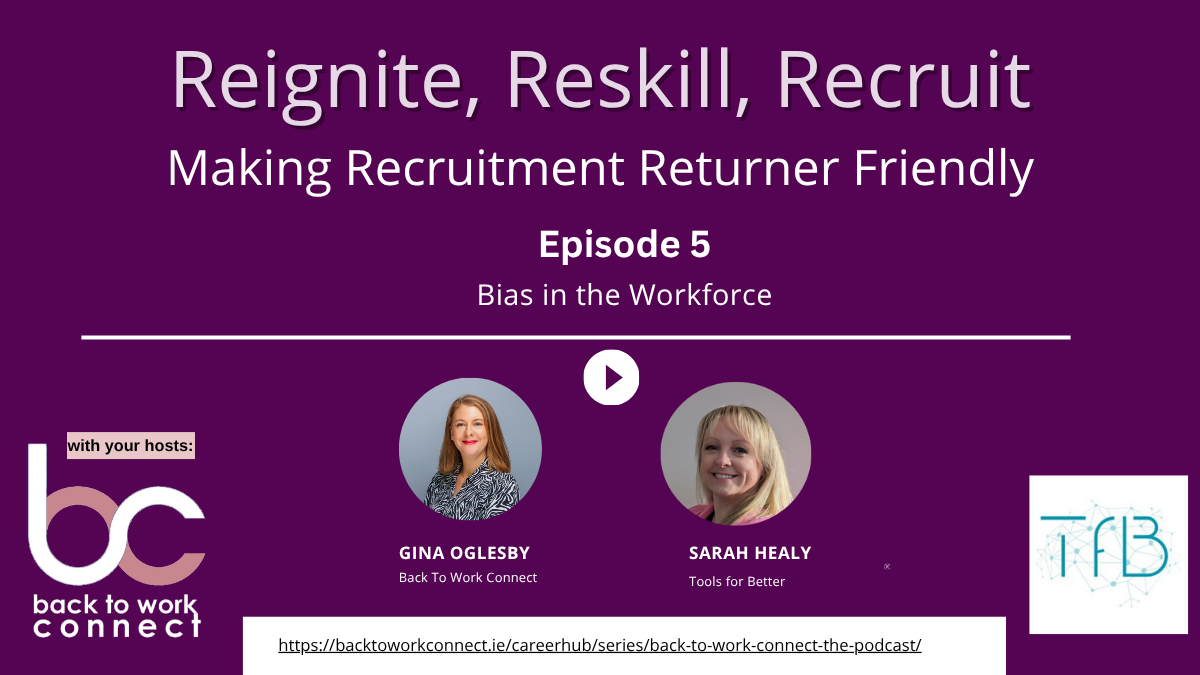

Welcome to Back To Work Connect’s Reignite, Reskill & Recruit Audio Series. In this episode, Sarah Healy of Tools for Better is discussing bias in the workplace.
Bias in the workplace is something we often associate with big, obvious issues. But in reality, it’s far more subtle—and far more common. It shows up in everyday decisions. In hiring. In performance reviews. In how we perceive people before we’ve even had a real conversation. And most importantly, it’s usually unconscious.
The Hidden Impact of Bias
Bias is not about bad intent. It’s about learned assumptions. Over time, we all develop mental shortcuts to make decisions quickly. But in the workplace, those shortcuts can quietly influence outcomes in ways we don’t realise.
Some of the most common types of bias include:
- Affinity bias – favouring people who are similar to us
- Confirmation bias – looking for evidence that supports what we already believe
- Halo or horns effect – letting one trait define our entire perception of someone
- Stereotyping – making assumptions based on age, appearance, or background
- Proximity bias – favouring those we see more often (especially relevant in hybrid work)
- Recency bias – prioritising recent experience over overall capability
Individually, these may seem small. But together, they shape who gets hired, who gets overlooked, and who gets the opportunity to grow.
Why This Matters for Returners
Returners, people re-entering the workforce after a career break—are particularly impacted by these biases.
A gap on a CV can trigger assumptions. Age can influence expectations. Outdated perceptions can overshadow real capability.
And yet, Returners often bring:
- Experience
- Resilience
- Transferable skills
- A high level of motivation to contribute
When bias goes unchallenged, businesses don’t just exclude people, they miss out on real value.
The Business Case for Change
Addressing bias isn’t just the right thing to do, it’s a smart business decision.
Organisations that actively work to reduce bias:
- Access a broader and more diverse talent pool
- Improve decision-making and innovation
- Strengthen employee engagement and retention
- Build a more inclusive and adaptable culture
In today’s talent market, overlooking skilled professionals simply isn’t an option.
Moving from Unconscious to Conscious
The goal isn’t perfection, it’s awareness. You can’t remove bias overnight, but you can start by recognising it. When teams understand how bias shows up, they can begin to:
- Question assumptions
- Make more objective decisions
- Design fairer recruitment processes
- Create opportunities for people who might otherwise be overlooked
That shift, from unconscious to conscious is where meaningful change happens.
How Back to Work Connect Supports This
At Back to Work Connect, we work with organisations to turn awareness into action.
Our Returner-Friendly Recruitment Training is designed to help businesses:
- Identify and challenge bias in hiring and progression
- Build inclusive, skills-focused recruitment practices
- Confidently engage with returner talent
- Create pathways for experienced professionals to re-enter and succeed
This isn’t just about opening doors, it’s about changing how those doors are designed.
A Better Way Forward
The future of work is inclusive, flexible, and skills-driven. Businesses that embrace this now will be the ones that thrive. Because when you remove bias, you don’t lower standards—
you expand opportunity.
And in doing so, you unlock talent that has been there all along.
Thank you for listening to Back To Work Connects reignite, reskill, and Recruit audio series. If you’d like to get more information, you can reach out to us at info@backtoworkconnect.ie.
#FutureOfWork #InclusiveHiring #Returners #TalentStrategy #Leadership #DiversityAndInclusion #WorkplaceCulture